Masks Make Relationships Impossible
The other day I came across an image I had saved years ago.
I remember seeing it for the first time and immediately thinking, Woah.
It hit me hard then, and honestly, it hit me just as hard this time.
The image shows a man removing a mask, only to reveal another mask underneath. Then another. Then another. Until eventually he peels away the final layer and reveals what he's been protecting all along: a wounded, frightened, vulnerable human being curled up inside.
The longer I looked at it, the more I realized why it resonated with me.
Not because I thought it was sad.
Because I recognized him.
Here it is…
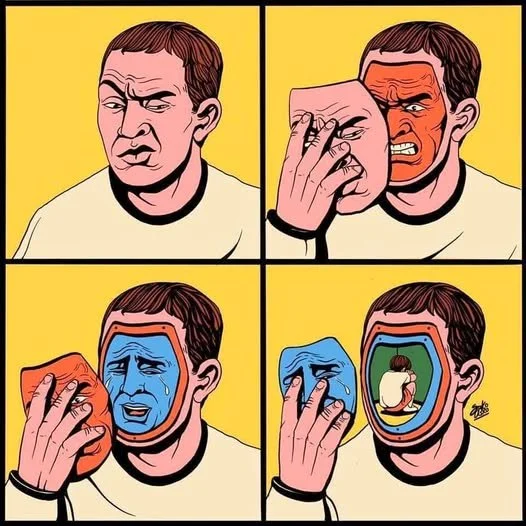
Over the last few years, I've been doing a lot of work on myself. Therapy. Prayer. Journaling. Writing. Self-reflection. Accountability. The kind of work that sounds inspiring until you're actually in the middle of it. The kind of work that requires you to sit with uncomfortable truths and ask questions you'd rather avoid. The kind of work that sucks when you’re in it, but you know will be for your greater good.
One thing I've discovered during that process is that most of us spend a surprising amount of energy managing how we're perceived. We want people to think we're strong. We want people to think we're successful. We want people to think we've got our lives together. We want people to think we're okay.
So we create masks.
Not because we're dishonest.
Because we're scared.
I don't think most people are pretending to be someone they're not. I think they're protecting parts of themselves they're afraid others won't understand. They're afraid of rejection. Afraid of disappointment. Afraid of being misunderstood. Afraid of being fully seen.
And if I'm being completely honest, I know that fear well. I do it all the time.
As I've worked through this Unpacking Jere journey, I've started noticing just how many masks I've worn over the years. Some were obvious: the theatre teacher, the director, the husband, the father, the leader, the mentor. Others were harder to spot: the strong one, the funny one, the helper, the encourager, the guy who has the answer, the person who can handle it all.
The thing is, none of those masks were entirely fake. Most of them were rooted in something true. I really am a teacher. I really do love making people laugh. I really do want to help people. But somewhere along the way, those identities stopped being things I did and started becoming armor I wore.
And armor is funny.
It protects us.
But it also keeps people from getting close.
The difficult thing about removing masks is that it often comes at a cost.
Sometimes people don't like what they find underneath.
Sometimes they discover you're not who they thought you were.
Sometimes they learn you're struggling.
Sometimes they realize you've changed.
Sometimes they find out you're carrying wounds they never knew existed.
And sometimes people become disappointed.
Sometimes they become critical.
Sometimes they judge.
Sometimes they pull away.
If I'm being honest, that's one of the reasons masks feel safer. The moment you stop presenting the version of yourself people expect, you're giving up control of how they'll respond.
Some people will celebrate your honesty. Others won't know what to do with it. Your vulnerability may challenge something in them. It may force them to examine their own masks. It may create discomfort. It may simply not fit the story they had written about who you were supposed to be.
Whatever the reason, not everyone will applaud your authenticity.
And that's okay.
One of the hardest lessons I've learned is that I am not responsible for managing other people's reactions to my truth.
For much of my life, I believed the opposite. I thought if I could just say things the right way, explain myself clearly enough, be kind enough, thoughtful enough, careful enough, then everyone would understand me.
What I've learned is that understanding isn't something I can create for another person.
I can communicate honestly.
I can speak with kindness.
I can clarify my intentions.
I can listen.
I can apologize when I'm wrong.
I can be accountable for my actions.
But I cannot control how someone receives what I've shared.
Whether they respond with understanding, disappointment, criticism, grace, or acceptance is ultimately outside of my control.
That's their work.
This is mine.
And the older I get, the more freedom I find in that truth.
That's part of what I was wrestling with when I wrote about being the villain in someone else's story. It was painful to realize that some of the decisions I made with the best intentions could still be viewed negatively by others. I spent a lot of time wishing I could change their perspective, clarify my motives, or somehow rewrite the story they had created about me.
But eventually I realized something important: their version of my story belongs to them.
Mine belongs to me.
And while that realization wasn't easy, it brought a level of clarity and peace I hadn't experienced before. It helped me understand that my responsibility is not to control other people's conclusions. My responsibility is to live with honesty, humility, and integrity—and allow others the freedom to draw their own.
Looking back, I think that lesson was helping me remove a mask I didn't even know I was wearing.
Because it means I don't have to spend my life managing everyone else's perceptions of me. I don't have to convince everyone to agree with me. I don't have to make sure everyone understands my journey. I don't have to be universally liked. I don't have to wear a mask simply because someone else prefers it.
My responsibility is to be honest about who I am.
Their responsibility is deciding what to do with that information.
The funny thing is, most of us think the mask protects us from pain.
And maybe for a while it does.
But eventually the mask becomes its own source of pain.
Because now we're carrying two burdens: the burden of whatever we're trying to hide and the burden of pretending we're not carrying it.
The longer I live, the more convinced I become that authenticity is one of the bravest things a person can choose. Not oversharing. Not dumping every thought and emotion onto everyone around us. Authenticity. The courage to be honest about who we are, where we are, and what we're carrying. The courage to say, "I don't have it all figured out." The courage to admit we're still learning, still growing, still healing, still becoming.
Healing and accountability require the same thing.
Honesty.
Not perfection.
Not performance.
Not image management.
Honesty.
The willingness to look at ourselves as we really are and say, "This is me."
The good. The bad. The strengths. The flaws. The victories. The failures. The parts we're proud of. And the parts we're still working on.
Maybe that's why God's invitation has always been so simple.
"Come as you are."
Not "Come as you pretend to be."
Not "Come as the version of yourself that has everything figured out."
Not "Come back when you've fixed all your flaws."
Just...
Come as you are.
Maybe the reason God keeps inviting us to step into the light isn't because He wants perfection.
Maybe it's because masks make relationships impossible.
God already knows what's underneath the masks.
The challenge isn't getting Him to see us.
It's finding the courage to believe we're still loved when we're fully seen.
Most of us spend our lives believing that if people really knew us, they might not love us. If they knew our doubts, our fears, our insecurities, our mistakes, our weaknesses, our struggles, they would turn away.
Yet the beautiful truth of the Gospel is that God already knows every single one of those things.
And He hasn't gone anywhere!
He doesn't love some future perfected version of us. He doesn't love the polished version. He doesn't love the version wearing all the right masks.
He loves the person underneath them.
The scared one.
The anxious one.
The grieving one.
The doubting one.
The imperfect one.
The one curled up in the center of that image trying desperately not to be discovered.
Maybe that's why this image has stuck with me all these years.
At first glance, it looks like a picture about sadness.
Now I think it's a picture about freedom.
Because every mask that comes off is one less thing to carry. One less performance to maintain. One less version of ourselves to protect.
Maybe growth isn't becoming someone new.
Maybe growth is having the courage to stop hiding.
To let people see us.
To let God heal us.
To believe that we are loved not because of the masks we've worn, but in spite of them.
Maybe that's what God has been teaching me all along.
Not how to become someone else.
But how to trust that the person underneath all the masks was worthy of love from the very beginning.
