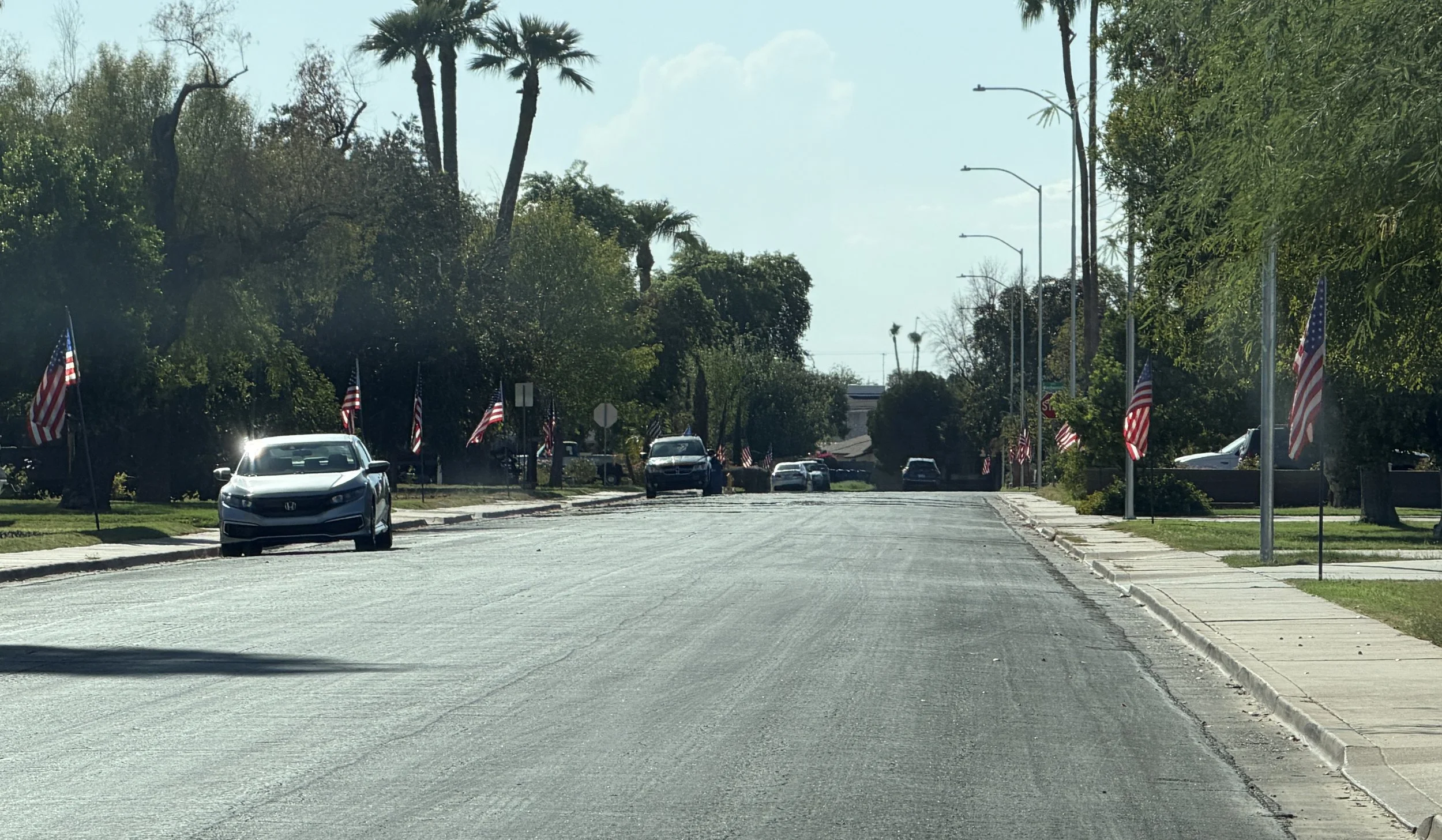
Remember September 12
Today marks twenty-five years.
Twenty-five years since a beautiful September morning became something else entirely. Twenty-five years since planes flew into buildings, smoke poured into a clear blue sky, people ran through streets covered in ash, and firefighters climbed stairwells while everyone else was desperately trying to get down. Twenty-five years since passengers aboard Flight 93 learned what was happening elsewhere and made an impossible decision. Twenty-five years since thousands of people went to work, boarded a plane, kissed someone goodbye, or walked out the door without any idea that they would never come home.
Twenty-five years since September 11, 2001.
I remember that day. Of course I do.
I wasn't in New York or Washington, D.C. I didn't know anyone aboard those planes. I didn't lose a family member or friend that morning. There is nothing particularly remarkable about my September 11 story. I was here in Arizona, and like millions of other Americans, I watched.
For hours.
We watched the same images over and over again, trying somehow to understand what we were seeing. How could this have happened? How could this have happened here? Was it over? Were there more planes? Were there more attacks coming? Who did this? Why? What happens now?
I remember the helplessness of it. The uncertainty. The strange, unsettled feeling that something fundamental had changed, although none of us knew yet exactly what that meant.
And I remember the grief.
That's the part that's difficult to explain twenty-five years later because it wasn't my loss. It was everyone's.
We were mourning people we'd never met. We were angry for families we didn't know. We cried over photographs of strangers and watched rescue workers searching for people whose names meant nothing to us the day before. Somehow their loss belonged to all of us. For a little while, there wasn't your tragedy and my tragedy. There was our tragedy.
There was fear in the days that followed. Absolutely. Is it over? Is there more? Are we safe? There was anger, too. We desperately wanted someone to blame because blame has a strange way of making the incomprehensible feel slightly more comprehensible. If there's a bad guy, maybe we can put all of this somewhere. Maybe we can make sense of something that makes no sense.
Some people took that fear and anger to terrible places. Muslim Americans, Sikhs, Arabs, and people who simply looked “different” were harassed, threatened, attacked, and blamed for something they had absolutely nothing to do with. I don't want to romanticize those days or pretend America suddenly became some perfect place where everybody held hands and got along.
We didn't.
There was ugliness and there was extraordinary beauty.
Somewhere inside all of the hurt and rage and shock, we also came together.
I remember President George W. Bush standing at Ground Zero with his arm around a firefighter, speaking through a bullhorn to the rescue workers surrounding him. When someone shouted that they couldn't hear him, he responded, “I can hear you! The rest of the world hears you! And the people who knocked these buildings down will hear all of us soon!”
It was a rallying cry.
I remember members of Congress standing together on the steps of the Capitol and spontaneously singing “God Bless America.” I remember people donating blood, giving money, bringing water, volunteering, joining the military, and showing up at Red Cross centers asking what they could do.
And I remember the flags.
So many flags.
They appeared on houses that hadn't flown them before. They hung from businesses and overpasses and car windows. They lined streets and neighborhoods. People seemed to find a deeper love for their country and a renewed pride in being American. There was a sense of brotherhood and camaraderie, generosity and compassion, pride and belonging.
For a moment, it seemed we understood something we routinely forget:
We belong to one another.
Maybe that's part of why I still love seeing the American flag flying. I love my country. I'm proud to be an American, and I'm not embarrassed to say either of those things.
I've heard people talk in recent years about feeling uncomfortable when they see an American flag because of what they believe it might represent about the person flying it, and that makes me sad. Because that's not what the flag means to me.
To me, it represents home and belonging and sacrifice. It reminds me of the people who serve this country and the people who have died doing so. It reminds me of firefighters climbing stairs while everyone else was coming down, of police officers and paramedics running toward something every human instinct told them to run away from, of passengers aboard Flight 93 deciding helplessness wasn't their only option. It reminds me of people digging through rubble, families waiting for phone calls, strangers donating blood, and young men and women raising their hands to serve.
It reminds me of people who looked around at a wounded country and asked, What can I do?
I understand that someone else's relationship with the flag may be more complicated than mine. That's okay. I don't need to tell someone else what the American flag must mean to them. I can only tell you what it means to me, and I can fly it proudly.
But twenty-five years later, I'm beginning to think the harder question isn't whether I'm willing to fly the flag. It's whether I'm willing to live what I believe it represents.
Because patriotism can't end with a piece of fabric hanging outside my house. If I say I love my country, surely that has to include loving the people who live in it—the people who agree with me and the people who don't, the people I understand and the people I don't, the people who look like me and those who don't, the people who worship differently than I do or don't worship at all, and the people whose experience with this country may be very different from mine.
Maybe loving your country isn't believing it's perfect. Maybe it's loving it enough to believe we can be better. Maybe pride in America doesn't have to mean We're better than everybody else. Maybe it can mean, I love this place. I love these people. And because I love them, I want us to be better to one another.
Which might explain why my favorite musical in the world is a musical about September 11 that takes place almost entirely outside the United States.
Come From Away tells the story of what happened when 38 planes carrying thousands of passengers were diverted to Gander, Newfoundland, after American airspace was closed on September 11. I've seen the show more times than I can count, and it still destroys me. One minute I'm crying, then I'm laughing, and before I know it I'm crying again.
The fascinating thing about Come From Away is that the attacks themselves happen almost entirely outside the story. Instead, it's about what ordinary people did because something terrible happened.
Thousands of people suddenly found themselves somewhere they never intended to be, carrying fear they never expected to carry, surrounded by strangers. The people of Gander couldn't solve 9/11. They couldn't get anybody home. They couldn't answer their questions, undo what had happened, or promise everything was going to be okay.
So they did what they could.
They made food. They found beds and gathered clothes. They opened schools, churches, and community centers. They helped people contact their families. They cared for animals trapped aboard the planes. They listened and cried and laughed and prayed and sat beside strangers who were terrified.
Nobody could fix the thing, so they helped carry the thing.
Maybe that's why I love that show so much. It's painful and touching and hilarious and devastating because that's what being human actually looks like. Grief and laughter. Fear and courage. Devastation and generosity. Strangers and family.
It's the And.
And there's something wonderfully ironic about the fact that one of my favorite stories about American patriotism didn't even happen in America. Because ultimately, Come From Away isn't really about being American.
It's about being human.
I thought about that today as I sat in my classroom in Arizona with a group of high school students and finished watching the show.
September 11 is a memory to me.
To them, it's history.
They weren't alive. They know the towers from photographs and videos and textbooks. I can tell them where I was. I can tell them what it felt like to watch television that morning. I can tell them about the fear and uncertainty, the flags and the unity, and the way the country seemed to change overnight.
And suddenly I realize I'm part of the generation telling the story now.
I've visited the 9/11 Memorial and Museum in New York several times, and every time I'm struck by the reverence of that place. The enormous scale of what happened becomes strangely intimate there.
Names.
So many names.
Not statistics. Not political arguments. Not historical talking points. People. Someone's husband. Someone's daughter. Someone's best friend. Someone's dad. Someone who had plans for dinner that night. Someone who was supposed to come home.
Standing there reduces this enormous historical event back down to its smallest—and perhaps most important—unit:
a human being.
And maybe that's what I've really been thinking about as this anniversary approached.
Not just September 11.
September 12.
I've been asking myself what exactly it is that I miss about those days afterward, and I certainly don't miss the fear. I don't miss the grief, anger, or uncertainty. I don't want another national tragedy. God forbid.
What I miss is what people did with all of those feelings.
They turned toward one another.
I miss the brotherhood. The camaraderie. The kindness. The generosity. The compassion and empathy. The encouragement. The sense that your neighbor's burden mattered because your neighbor mattered.
Maybe some of this is landing differently for me this year because I've had my own season of feeling a little more alone than usual. There's nothing particularly unique about that. Most of us know what it's like to carry something heavy while the rest of the world keeps moving, and perhaps that's made me think a little more about what happens when somebody notices. When somebody helps carry a corner of it.
Because life is hard enough without believing we have to do all of it alone.
And yet, when I look around today, it sometimes feels like we've become very good at identifying all the ways we're different from one another. We're good at labels and camps, at deciding who the bad guy is, at assuming and accusing and becoming outraged. It feels much harder to extend understanding, compassion, or even the benefit of the doubt.
I wonder whether somewhere along the way we've gotten worse at simply looking at another human being and thinking:
You don't have to carry this alone.
I don't know how to reunite a country. I don't know how to fix division or make people stop assuming the worst about one another. I can't fix the anger or the fear. I can't fix all of the things in my own life that hurt, let alone anyone else's.
And.
I can notice somebody. I can listen. I can be generous. I can encourage. I can make somebody laugh. I can sit beside someone who's hurting. I can make one person's burden a little lighter.
Maybe that's what the people of Gander still have to teach us twenty-five years later.
They didn't stop the planes. They didn't defeat terrorism or solve an international crisis.
They made sandwiches.
They found blankets. They opened doors. They answered phones. They cared for strangers.
And twenty-five years later, we're still telling their story.
Maybe patriotism begins with loving a country, but perhaps its best expression is loving the people who make up that country. And maybe beyond patriotism there is something even bigger: humanity. Being proud not only to be American, but proud of what human beings are capable of being for one another.
So yes, remember September 11.
Remember the towers and the Pentagon and Flight 93. Remember the first responders and the people who ran toward danger. Remember those who went to work that morning and never came home. Remember their families. Remember the sacrifice and the fear. Remember the flag.
Fly it proudly.
Tell the stories.
Teach the next generation.
Remember.
And remember September 12.
Remember the blood donors and the volunteers. Remember the strangers helping strangers. Remember the meals and the phone calls. Remember the laughter that somehow found its way into grief. Remember Gander. Remember what happened when ordinary people looked at frightened strangers and decided, You're not carrying this alone.
We shouldn't need another tragedy to remember how to be human. We shouldn't need buildings to fall before we look up and notice one another. We shouldn't need catastrophe to remind us that our neighbor's pain matters.
We shouldn't need September 11 to become the people we were on September 12.
Twenty-five years later, I haven't forgotten what happened on September 11.
But I'm beginning to wonder whether we've forgotten what happened on September 12.
Maybe it's time we remembered.